Labels

Aberdeenshire (21) Angus (4) antiquities (87) Argyll and Bute (35) Arran (7) art (37) birds (231) bridge (9) Caithness (12) Carmarthenshire (5) castle (164) Ceredigion (9) Channel Islands (13) Cheshire West and Cheshire (1) City and County of Swansea (1) City of Bristol (2) City of Edinburgh (4) Conwy (8) Cornwall (74) County Antrim (19) County Down (23) County Durham (3) County Londonderry (4) Cumbria (19) Denbighshire (2) Devon (48) diving (9) Dorset (18) Dumfries and Galloway (22) Dundee City (1) East Lothian (6) East Sussex (16) East Yorkshire (6) English Riviera (3) Essex (17) Fife (19) Flintshire (1) food (12) fossils (14) gardens (28) Ghosts (36) Glamorgan (1) Gower (7) Guernsey (4) Gwent (1) Gwynedd (19) Hampshire (13) Highland (72) Inner Hebrides (42) Inverclyde (5) Islay (8) Isle of Anglesey (14) Isle Of Man (7) Isle Of Wight (10) Isles of Scilly (3) Jersey (7) Kent (22) Lancashire (8) Lewis and Harris (7) lighthouse (62) Lincolnshire (8) Merseyside (8) Mid Glamorgan (1) mining (23) Moray (10) Mull (8) Norfolk (21) North Ayrshire (13) North Yorkshire (12) Northern Ireland (45) Northumberland (17) Orkney (10) Outer Hebrides (14) Pembrokeshire (27) pubs (50) Ross and Cromarty (20) Scotland (299) Scottish Borders (3) Shetland (14) shipwrecks (42) Skye (12) smuggling (48) Somerset (9) South Ayrshire (6) South Glamorgan (5) South Gloucestershire (2) Suffolk (18) surfing (92) Sutherland (16) Tyne and Wear (8) Wales (93) wartime (75) webcams (232) West Dunbartonshire (3) West Glamorgan (9) West Sussex (9)
Showing posts with label County Londonderry. Show all posts

Monday, 4 June 2018

CULMORE


Culmore is at the mouth of the River Foyle, a short distance downstream from the city of Londonderry, or Derry, slightly further inland.  This geographical location proved to be of strategic importance in May 1600 when Sir Henry Docwra, 1st Baron Docwra of Culmore, landed here with his army prior to taking Derry in an attempt to quash a war against the crown in Ulster.  The 17th century Fort Culmore on Culmore Point played a part in another event a few years later when Sir Cahir O’Doherty captured a supply of arms from there before launching what came to be known as O’Doherty’s Rebellion.  A more recent claim to fame for the village is that Amelia Earhart completed her solo translatlantic flight in 1932 by coming down on Culmore. 


Just beyond Culmore is the border with the Republic of Ireland, making it the last mainland coastal settlement on my blogging odyssey around the British coast.  However, there is one last place to blog about: Rathlin Island.  Watch this space.
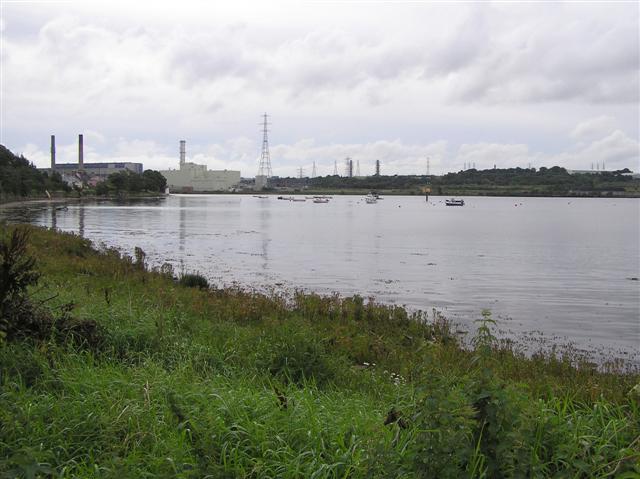

File:Culmore point - geograph.org.uk - 953319.jpg
Culmore Point - geograph.org.uk - 953319. Photo by Kenneth Allen, via Wikimedia Commons.


Thursday, 24 May 2018

MAGILLIGAN POINT


Well, I am nearing the end of my blogging journey around the British coast, and this is the last headland before the border with the Republic of Ireland.  Poking out into the mouth of Lough Foyle, Magilligan Point is a short distance from the Republic and there is a year-round ferry to Greencastle on the other side.  A short distance from the ferry crossing point is a Martello tower built during the Napoleonic Wars to protect the lough from those pesky French, but also as a defence against American privateers.  Group tours of the tower can be undertaken by arrangement.  The tower stands within the Magilligan Point Nature Reserve, distinguished by its extensive system of sand dunes, the largest in Northern Ireland.  The flora growing among the dunes attract a variety of insects such as bees and moths, including the rare Scarce Crimson and Gold Moth, a variety of moth only found along this coast.


File:Martello Tower, Magilligan Point - geograph.org.uk - 583940.jpg
Martello Tower, Magilligan Point - geograph.org.uk - 583940. Photo by Ross, via Wikimedia Commons.


Friday, 18 May 2018

CASTLEROCK


The kilometre-long stretch of sandy beach stretching to the west of the mouth of the River Bann belongs to the small resort of Castlerock.  The beach is adjacent to the Castlerock Golf Club and its dunes continue upstream to a National Trust bird sanctuary.  Wildlife enthusiasts should keep their eyes peeled when eyeing the estuary as harbour porpoises and seals can sometimes be seen feeding there.  Castlerock’s celebrity claim to fame is that the actor James Nesbitt called the resort home when a teenager. 


Another famous name associated with Castlerock is the author C. S. Lewis, who used to holiday there when growing up in Belfast.  Lewis used to visit the nearby Downhill Demesne, and was so captivated by the site that it provided inspiration for some of his work, including The Lion, the Witch and the Wardrobe.  The Demesne is run by the National Trust and includes the ruined 18th century mansion Downhill House, a Mausoleum, a Dovecote and an Icehouse among its points of interest.  For nature lovers there are The Bog Garden, The Black Glen, and there is a Walled Garden which nowadays is home to sheep and apple trees.  Another attraction within the Demesne is the clifftop Mussenden Temple, which is based on the Temple of Vesta in Italy, and which, along with the beautiful beach it overlooks, featured in Game of Thrones as Dragonstone.  By the way, the word 'demesne' is used in Ireland to mean a piece of land attached to a manor.


File:Mussenden Temple overlooking Downhill beach. Northern Ireland.jpg
Mussenden Temple overlooking Downhill beach. Northern Ireland. Photo by D LN, via Wikimedia Commons.


Thursday, 10 May 2018

PORTSTEWART


In a dramatic scene from series 5 of Game of Thrones, Jaime Lannister and Bronn are seen duelling with the Dornish guards on a stunning beach.  The beach in question was the Strand of Portstewart, just across the county border from Portrush, in County Londonderry.  The timing of the filming, which took place in 2014, was unfortunate, being in August, the busiest time of the year, as the beach had to be completely closed for it.  However, there was significant payback for the resort, which gained valuable exposure as a result of its starring role in the series.


The Portstewart Strand, which holds Blue Flag status, stretches out from the mouth of the River Bann, with the Portstewart Golf Club at one end.  The beach is popular with surfers, and in the town there is a Dive Centre for divers at Aquaholics, where boat trips can also be booked.  On the opposite bank of the river and inland a bit is a bird hide run by the National Trust (as is the Strand itself).  The hide offers the opportunity to observe waterfowl, waders and nesting birds.  The built up part of Portstewart lies to the other side of the golf course, occupying an area surrounding a small rocky peninsula, and it has a range of cafes, restaurants, pubs and shops for visitors to choose from.  There is a promenade leading to the Strand, taking in a small harbour. 


File:The Promenade at Portstewart - geograph.org.uk - 1322701.jpg
The Promenade at Portstewart - geograph.org.uk - 1322701. Photo by Des Colhoun, via Wikimedia Commons.