Labels

Aberdeenshire (21) Angus (4) antiquities (87) Argyll and Bute (35) Arran (7) art (37) birds (231) bridge (9) Caithness (12) Carmarthenshire (5) castle (164) Ceredigion (9) Channel Islands (13) Cheshire West and Cheshire (1) City and County of Swansea (1) City of Bristol (2) City of Edinburgh (4) Conwy (8) Cornwall (74) County Antrim (19) County Down (23) County Durham (3) County Londonderry (4) Cumbria (19) Denbighshire (2) Devon (48) diving (9) Dorset (18) Dumfries and Galloway (22) Dundee City (1) East Lothian (6) East Sussex (16) East Yorkshire (6) English Riviera (3) Essex (17) Fife (19) Flintshire (1) food (12) fossils (14) gardens (28) Ghosts (36) Glamorgan (1) Gower (7) Guernsey (4) Gwent (1) Gwynedd (19) Hampshire (13) Highland (72) Inner Hebrides (42) Inverclyde (5) Islay (8) Isle of Anglesey (14) Isle Of Man (7) Isle Of Wight (10) Isles of Scilly (3) Jersey (7) Kent (22) Lancashire (8) Lewis and Harris (7) lighthouse (62) Lincolnshire (8) Merseyside (8) Mid Glamorgan (1) mining (23) Moray (10) Mull (8) Norfolk (21) North Ayrshire (13) North Yorkshire (12) Northern Ireland (45) Northumberland (17) Orkney (10) Outer Hebrides (14) Pembrokeshire (27) pubs (50) Ross and Cromarty (20) Scotland (299) Scottish Borders (3) Shetland (14) shipwrecks (42) Skye (12) smuggling (48) Somerset (9) South Ayrshire (6) South Glamorgan (5) South Gloucestershire (2) Suffolk (18) surfing (92) Sutherland (16) Tyne and Wear (8) Wales (93) wartime (75) webcams (232) West Dunbartonshire (3) West Glamorgan (9) West Sussex (9)
Showing posts with label art. Show all posts

Thursday, 20 October 2016

ST IVES


When I was growing up in Penzance I used to love jumping on the No. 17 bus to St Ives for the day (incredibly, several decades later it is still the No. 17).  In truth, St Ives was a bit on the tacky side in those days, not that it bothered me as a child.  However, that certainly cannot be said now, with a host of smart restaurants and upmarket accommodation options gracing the town.  I read somewhere recently that St Ives is the most expensive place to stay in Cornwall, even outstripping Padstein, though there are still some affordable options for those on a budget.  

The main factor that propelled the town into the touristic stratosphere, apart from its stunning appearance, was probably the opening of the Tate St Ives, the Cornish outpost of the famous London art gallery, which occupies a position overlooking Porthmeor Beach and which boasts a top floor cafe with sea views.  St Ives was the obvious choice of  location for the gallery, given its long-standing artistic pedigree.  The town, which has always been celebrated by artists for its exceptional light, has for years it been a magnet, and not only for painters.  One of the most famous names from the art world to live in the town was the sculptress Barbara Hepworth.  Although she died in 1975, her memory lives on in the form of the Barbara Hepworth Museum and Sculpture Garden, which comes under the umbrella of the Tate.  There is much to inspire artists living in and visiting the town, especially in the old quarter bordering the harbour, where ancient whitewashed fishermen’s cottages line the winding alleyways.  Needless to say, a large proportion of these cottages have been turned into holiday homes.

The other big draw for visitors to St Ives is the town’s fabulous beaches.  As well as the above-mentioned Porthmeor Beach, the other main beach is Porthminster, just below the railway station.  Both beaches are gloriously sandy, and both have smart restaurants for more upmarket grub as a change from the ubiquitous pasties and fish and chips.  In between the two is the harbour, with another small beach, and then there is the ‘Island’, not actually an island but a small promontory with a chapel on top.   The diminutive St Nicholas Chapel, also known as the Island Chapel, dates back to at least the 15th century, though no-one is sure when exactly.  Seals and dolphins can sometimes be seen from the area near the coastwatch station on the Island.  Further along the coast is Seal Island, visited by boat trips from the harbour. Back in the fishermen's quarter, the St Ives Museum, occupying a building once used for pilchard curing, is a treasure trove of memorabilia from the town's past.  Another museum is the Capt Sir Richard Francis Burton Museum, dedicated to the exploits of a Victorian adventurer, explorer, spy and translator of the Kama Sutra.

As is to be expected from such a popular tourist town, there are a plethora of takeaways for those wanting to enjoy a bite to eat al fresco.  However, I feel I must issue a word of warning for anyone tempted to indulge in takeaway food outside, particularly in the vicinity of the harbour: seagulls!  The seagulls of St Ives must surely be the biggest in the country, and they have acquired an almost mythical reputation for their voracity and their brazenness in their quest for free grub.  As an example, a few years ago I was wandering by the harbourside tucking into an ice cream.  Suddenly a gull appeared from behind at great speed and snatched the ball of ice cream from the cone.  I was just getting over the shock of that when another one came along and snatched the cone, leaving me with nothing.  The only consolation was that it provided a good deal of entertainment for a little boy passing nearby with his dad.

St Ives hosts a number of festivals and other events throughout the year.  For a list of events in the  town follow this link.

Webcam view of the harbor.

Map of the area. 
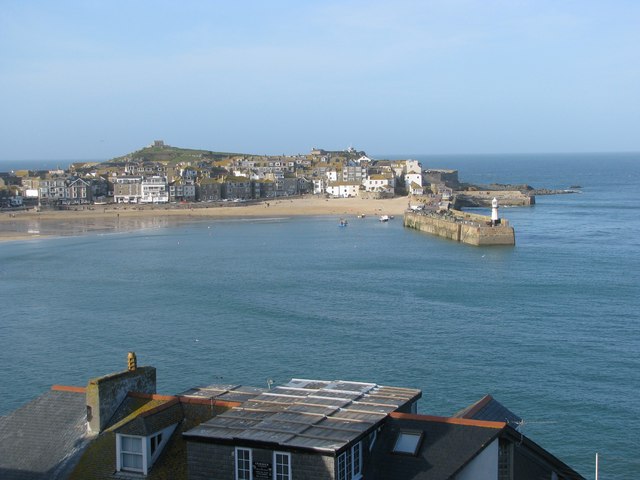
File:St Ives Harbour over the rooftops - geograph.org.uk - 1206991.jpg
St Ives Harbour over the rooftops - geograph.org.uk - 1206991. Photo by Sarah Charlesworth, via Wikimedia Commons.

Thursday, 24 December 2015

ILFRACOMBE


I am a big fan of the Ward Lock Red Guides, a series of vintage guidebooks which give a fascinating insight into what tourism was like in Britain in past decades.  Looking at the entry for Ilfracombe in the 1966 edition of the North West Devon guide, I was astonished at the range of ‘steamer’ services available in those days.  The guide lists the following: “Steamer services and excursions to Lynmouth, Clovelly, Minehead, Bristol, Cardiff, Barry and Swansea etc., also channel cruises and trips to Lundy, Mumbles, Tenby, etc.”  Today, the only regular crossing still available is to Lundy during the summer months, and Ilfracombe is also one of the departure points for trips on the Waverley paddle steamer.  Ilfracombe also had a railway station in 1966, and there was a rail booking office in the High Street.  Those were the days.

The first thing that strikes the visitor to Ilfracombe is the stunning coastal scenery all around it.  Seen from an elevated position the harbour area of the town looks a lot like St Ives, complete with a little chapel on a crag at the harbour entrance.  St Nicholas Chapel, dating from 1321, once housed a lighthouse keeper and his family including 14 children, but fell into neglect.  It was restored in 1962 by the local Rotary Club, who still look after it today, welcoming visitors who want to have a look around  inside where there is a small local history museum – free to enter though donations are welcome.  Another feature of Ilfracombe which makes an interesting, and quite unique, destination for visitors is Tunnels Beaches, where there are two large tide-filled pools originally built in Victorian times for single-sex bathing.  As the name suggests, the pools are accessible via tunnels for an entrance fee; nowadays there are many more additions to the original attraction, such as a cafe bar, a shop and a play hut. 

During recent years, the controversial artist Damian Hurst has started to make his mark in  Ilfracombe.  First he opened a restaurant there, but this has since closed.  What does still remain, though is a sculpture named Verity, depicting a naked pregnant woman brandishing a sword while carrying the scales of justice.  Not surprisingly, the sculpture has split the local populace right down the middle, with many decrying the grotesque nature of the sculpture.  The official webpage for the sculpture claims that Verity is an”allegory for truth and justice”. Back on more normal ground, the Ilfracombe Museum on the promenade is in Runnymede Gardens, and offers displays for all the family, and there is an Aquarium on the Harbourside.  The Landmark Theatre occupies a cliff-top position, making its cafe bar a lively lunchtime venue during rough seas.   For diving enthusiasts, Ilfracombe-based Easy Divers offers courses and diving trips, including opportunities for seal encounters off Lundy Island.

For a list of events in Ilfracombe, follow this link.

Live streaming webcam view of Ilfracombe Bay.

Map of the area. 

Boats in the harbour at low tide

File:Beacon Point Ilfracombe, from Capstone - geograph.org.uk - 1495423.jpg
Beacon Point Ilfracombe, from Capstone - geograph.org.uk - 1495423.  Photo by Barrie Cann, via Wikimedia Commons.