Labels

Aberdeenshire (21) Angus (4) antiquities (87) Argyll and Bute (35) Arran (7) art (37) birds (231) bridge (9) Caithness (12) Carmarthenshire (5) castle (164) Ceredigion (9) Channel Islands (13) Cheshire West and Cheshire (1) City and County of Swansea (1) City of Bristol (2) City of Edinburgh (4) Conwy (8) Cornwall (74) County Antrim (19) County Down (23) County Durham (3) County Londonderry (4) Cumbria (19) Denbighshire (2) Devon (48) diving (9) Dorset (18) Dumfries and Galloway (22) Dundee City (1) East Lothian (6) East Sussex (16) East Yorkshire (6) English Riviera (3) Essex (17) Fife (19) Flintshire (1) food (12) fossils (14) gardens (28) Ghosts (36) Glamorgan (1) Gower (7) Guernsey (4) Gwent (1) Gwynedd (19) Hampshire (13) Highland (72) Inner Hebrides (42) Inverclyde (5) Islay (8) Isle of Anglesey (14) Isle Of Man (7) Isle Of Wight (10) Isles of Scilly (3) Jersey (7) Kent (22) Lancashire (8) Lewis and Harris (7) lighthouse (62) Lincolnshire (8) Merseyside (8) Mid Glamorgan (1) mining (23) Moray (10) Mull (8) Norfolk (21) North Ayrshire (13) North Yorkshire (12) Northern Ireland (45) Northumberland (17) Orkney (10) Outer Hebrides (14) Pembrokeshire (27) pubs (50) Ross and Cromarty (20) Scotland (299) Scottish Borders (3) Shetland (14) shipwrecks (42) Skye (12) smuggling (48) Somerset (9) South Ayrshire (6) South Glamorgan (5) South Gloucestershire (2) Suffolk (18) surfing (92) Sutherland (16) Tyne and Wear (8) Wales (93) wartime (75) webcams (232) West Dunbartonshire (3) West Glamorgan (9) West Sussex (9)
Showing posts with label South Ayrshire. Show all posts

Monday, 17 June 2013

BALLANTRAE


People who, like me, enjoy looking at old photographs may want to check out the Ballantrae website, which has a nice collection of old images of the village, some looking out to sea, with the ever-present Ailsa Craig on the horizon, others showing street scenes with the residents in their fashion of the day.  The website also has a fascinating timeline of events, happy and sad, which have taken place there over the years, starting from 1806.  Another interesting feature of the website is a table showing a comparison between the 1900 village and the present one.  As a sad sign of the times, it reveals that in 1900 there were 6 grocers, but only one now; there was a baker in 1900, now there are none; and in 1900 there was a post office, while the present-day post office is inside the grocers.  The shingle beach at Ballantrae is a nature reserve, classed as a Site of Special Scientific Interest, with nesting grounds in the nearby cliffs.  The beach lies between the harbour at the north end and the mouth of the River Stinchar at the south end, which is dominated by the ruins of Ardstinchar Castle, once home to the Kennedys of Bargany, where Mary Queen of Scots spent a night in August 1566.  The village was immortalised in literature in a book by Robert Louis Stevenson called The Master of Ballantrae, about a family feud during the Jacobite Uprising.  Ballantrae has its own Gala Week, which this year starts on 29th June, preceded by the crowning of the Gala Queen and Gala King on 14th June.

Map of the area. 

Ardstinchar Castle and bridge, Ballantrae, Scotland-LCCN2001703588. Photo courtesy of United States Library of Congress, via Wikimedia Commons.


Friday, 14 June 2013

GIRVAN AND AILSA CRAIG

Girvan was granted burgh status in 1668, and its economy developed from shoemaking, weaving and fishing.  The town became a popular resort with the arrival of the railway in 1860, bringing daytrippers from Glasgow.  There is still an active fishing fleet operating from the harbour, which lies at the mouth of the river named the Water Of Girvan.  Girvan's beaches offer views to Arran to the north, and to Ailsa Craig out at sea, including a nice view from the local golf course.  The town centre is dominated by the spire of North Parish Church, which was built in 1883.  Another prominent tower is Auld Stumpy, the last surviving part of McMaster Hall, which burned down in 1939.  The McKechnie Institute in the centre of town is an art gallery and museum with changing exhibitions.  Each year in early summer the Carrick Lowland Gathering takes place in Girvan, with traditional Scottish entertainment such as pipe bands and a highland dancing competition.  Another major event in June is the Gig On The Green, with a variety of bands and other entertainment.

Looking out to the horizon west of Girvan, the eye is drawn to a distinctive small island rising up out of the sea.  This is Ailsa Craig, which is visible from miles around - I remember seeing it when visiting the Mull Of Kintyre a few years ago.  The name of the island, which is 10 miles offshore from Girvan, comes from the Gaelic for "Fairy Rock".  It was part of an ancient volcano, and features the typical columnar rock formations seen in a number of places in this part of the world - Fingal's Cave and The Giant's Causeway being two more examples.  The rock is a source of a particularly prized form of granite which is used to make curling stones.  In the 19th century there were around 29 inhabitants, working in the quarries and the lighthouse, built in 1883-1886 by Thomas and David Stevenson, but as the quarries closed and the lighthouse went automatic the island became depopulated save for its huge seabird colonies.  The island is home to one of the world's largest gannet colonies with over 70,000 birds, and it has been designated a European Special Protection Area.  Ailsa Craig can be reached by boat from Girvan.

Map of the area.  


File:By The North Breakwater - geograph.org.uk - 1068562.jpg

By The North Breakwater - geograph.org.uk - 1068562. Photo by Mary and Angus Hogg, via Wikimedia Commons

Wednesday, 12 June 2013

MAIDENS AND TURNBERRY


Maidens originated as a fishing village, and it has a number of old buildings with interesting connections.  Robert Burns used to drink in The Cellars, among the oldest buildings in the village but which has since been modernised.  Meanwhile, just outside the village is Shanter Farm, where one of Burns' most famous characters, Tam O'Shanter, lived.  There is another old cottage with the intriguing name "Weary Nuek".  Robert The Bruce allegedly landed here from Rathlin Island in 1307, sat down on a stone at the site of the cottage and declared that "this is a weary, weary nuek".

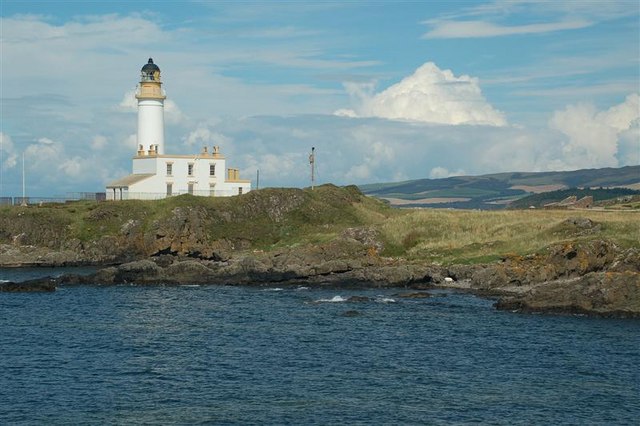
Looking at the map of Turnberry, one prominent feature stands out: a stonking great golf course.  This is the Ailsa, one of the courses afforded the honour of hosting the Open Championship.  The course is named after a distinctive island out to sea called Ailsa Craig which can be seen on the horizon, a sight which is particularly memorable when backed by a magnificent sunset.  Another notable feature in the view from the golf course is the Turnberry lighthouse, 24 metres high and built in 1873 to a design by David and Thomas Stevenson.  The Ailsa, along with another course called The Kintyre, form part of the luxurious Trump Turnberry Resort.  The resort opened in 1906, with the hotel at its heart then named the Station Hotel.  During World War I the resort was used as an airbase, and the disused landing strip is still visible.  The Royal Flying Corps used the site for training purposes, and the hotel itself was used as a hospital for the wounded.  This scenario was repeated during World War II, this time with the Royal Air Force doing the training.  There is a memorial to lost airmen on a hill overlooking the 12th green.


File:Turnberry Lighthouse - geograph.org.uk - 907831.jpg

Turnberry Lighthouse - geograph.org.uk - 907831. Photo by Mary and Angus Hogg, via Wikimedia Commons


Monday, 10 June 2013

CULZEAN CASTLE


Culzean Castle, designed by Robert Adam, was built as a "bachelor pad" for David Kennedy, 10th Earl of Cassillis.  Construction took place over a number of years between 1777 and 1792.  However, the site was previously inhabited during medieval times, when a network of fortified caves were established below the present castle's clifftop location.  During the 18th century the Firth of Clyde was a notorious centre of smuggling.  Alcohol, tobacco and silks were brought over from Ireland and the Isle Of Man and the caves proved an ideal place for hiding the contraband from the Revenue.  We cannot be sure whether the Kennedy family knew what was going on under their noses, but it seems likely that they did know, and that they were willing to turn a blind eye in return for a share of the profits.  In 1945 General Dwight D. Eisenhower was gifted a suite of rooms at the top of the castle in a show of gratitute for his services during the Second World War.  Eisenhower gratefully accepted, and visited the castle several times, including once after he became President of the USA.  These apartments are now available for rent from the National Trust of Scotland.   Culzean Castle has an intriguing collection of ghosts and paranormal phenomena, and once featured in the Most Haunted TV series.  Spooky occurrences at the castle have included: the sound of bagpipes at a tree-lined walk called Piper's Brae, but no sign of anyone playing them; a misty shape moving up the oval staircase; the ghost of a woman in a ballgown; and the White Lady, thought to be the ghost of an ill-treated maid.

Map of the area. 

File:Culzean and Mochrum Hill - geograph.org.uk - 231308.jpg

Culzean and Mochrum Hill geograph.org.uk - 231308. 
. Photo by Mary and Angus Hogg, via Wikimedia Commons

Thursday, 6 June 2013

PRESTWICK AND AYR


Prestwick, which is the oldest burgh in Scotland, having been granted the honour in 987, is just to the north of Ayr, and more or less runs straight into its larger neighbour.  Prestwick was the original home of golf's Open Championship, which was played out on its12-hole course in the years from 1860 to 1872.  The first tournament was over in a day, involving just eight golfers, all of them professionals, each playing three rounds.  St Ninian's church on the south side of town includes a well called Bruce's Well, the reason for the name being that Robert The Bruce was supposedly cured of leprosy by the waters from the well.

Ayr is one of the most popular resorts on this stretch of coast.  Its charms were not lost on Robert Burns, who in Tam O'Shanter written in 1791 described the town as "Auld Ayr, wham ne'er a toun surpasses, For honest men and bonnie lasses".  Earlier, in the 13th century, William Wallace was too busy engaging in increasingly violent encounters with the English soldiers garrisoned there to notice the area's delights.  During medieval times, Ayr was the most prominent harbour town on the west coast of Scotland.  By the 18th century the harbour was facilitating trade across the Atlantic, and in the 19th century it became a major industrial port.  It was also in the 19th century that Ayr blossomed into a smart resort with attractive parks and golf courses.  The town is an essential stopover for Robert Burns fans.  Burns was born in the southern outskirts of the town, and his birthplace is now a museum.  He was baptised in the 17th century Auld Kirk.  The Tam O'Shanter pub, which was frequented by Burns, was formerly a museum.  As if these were not enough reminders of the town's associations with the poet, there is a Burns Monument, designed in 1820 by Thomas Hamilton.  Other leisure activities in the town include sea-fishing trips from the harbour and the town is visited by the Waverley Paddle Steamer.  There is a lovely beach in the south of Ayr Bay dominated by the Heads of Ayr cliffs.  This area also houses the ruins of the 16th century Greenan Castle, built by John Kennedy of Baltersan and occupying a perilous clifftop location.  There is also a popular farm park in the vicinity.  

For a list of events in Ayr and the surrounding area see here

Map of the area.

File:Ayr from Brown Carrick Hill - geograph.org.uk - 372659.jpg

Ayr from Brown Carrick Hill - geograph.org.uk - 372659. Photo by Mary and Angus Hogg, via Wikimedia Commons

Tuesday, 4 June 2013

TROON


It could be said that Troon is the west coast of Scotland's answer to St Andrews.  The town has six golf courses, one of which, the Royal Troon Golf Club, is one of a handful of courses afforded the honour of hosting the Open Championships.  The next time the Troon Royal is due to hold the Open is in 2016, but at the end of this month the Byrne Howard Junior Open is due to take place.  As well as golf, Troon is a popular resort for waterborne activities, in particular sailing and kitesurfing.  Pleasant walking can be had on a footpath which runs behind the curving sands of South Beach.  Early in the 19th century the first railway in Scotland brought coal from inland to the harbour at Troon.  The harbour used to be the focus of much of the local economic activity, from shipbuilding at the Ailsa Shipbuilding Company to fishing, after the fishing fleet at Ayr moved to Troon.  Nowadays, however, the harbour is given over to leisure craft.

The Live@Troon music festival takes place in early September.  

Live streaming webcam views from Troon Yacht Haven.

Map of the area. 

File:Troon Yacht haven - geograph.org.uk - 50700.jpg

Troon Yacht haven - geograph.org.uk - 50700. Photo by Gordon Brown, via Wikimedia Commons