Labels

Aberdeenshire (21) Angus (4) antiquities (87) Argyll and Bute (35) Arran (7) art (37) birds (231) bridge (9) Caithness (12) Carmarthenshire (5) castle (164) Ceredigion (9) Channel Islands (13) Cheshire West and Cheshire (1) City and County of Swansea (1) City of Bristol (2) City of Edinburgh (4) Conwy (8) Cornwall (74) County Antrim (19) County Down (23) County Durham (3) County Londonderry (4) Cumbria (19) Denbighshire (2) Devon (48) diving (9) Dorset (18) Dumfries and Galloway (22) Dundee City (1) East Lothian (6) East Sussex (16) East Yorkshire (6) English Riviera (3) Essex (17) Fife (19) Flintshire (1) food (12) fossils (14) gardens (28) Ghosts (36) Glamorgan (1) Gower (7) Guernsey (4) Gwent (1) Gwynedd (19) Hampshire (13) Highland (72) Inner Hebrides (42) Inverclyde (5) Islay (8) Isle of Anglesey (14) Isle Of Man (7) Isle Of Wight (10) Isles of Scilly (3) Jersey (7) Kent (22) Lancashire (8) Lewis and Harris (7) lighthouse (62) Lincolnshire (8) Merseyside (8) Mid Glamorgan (1) mining (23) Moray (10) Mull (8) Norfolk (21) North Ayrshire (13) North Yorkshire (12) Northern Ireland (45) Northumberland (17) Orkney (10) Outer Hebrides (14) Pembrokeshire (27) pubs (50) Ross and Cromarty (20) Scotland (299) Scottish Borders (3) Shetland (14) shipwrecks (42) Skye (12) smuggling (48) Somerset (9) South Ayrshire (6) South Glamorgan (5) South Gloucestershire (2) Suffolk (18) surfing (92) Sutherland (16) Tyne and Wear (8) Wales (93) wartime (75) webcams (232) West Dunbartonshire (3) West Glamorgan (9) West Sussex (9)
Showing posts with label lighthouse. Show all posts

Monday, 4 December 2017

WHITEHEAD


Whitehead, on the north shore of Belfast Lough, is a small seaside town midway between Carrickfergus and Larne.  The town was originally called Chichester, and the ruins of Castle Chichester, built by Sir Moses Hill, are still on view in Chester Avenue.  The town became a railway town during Victorian times and its attractions include a Railway Museum which tells the history of trains in Ireland and which, judging from the comments on TripAdvisor, is a hit with visitors whether or not they are into trains.  The famous Portrush Flyer steam train is on view there.  The local Golf Club has a restaurant with fine views over the area.

There is a lovely walk leading from the Boat Club in Whitehead to Blackhead and its lighthouse, taking in habitats such as the woodland known locally as the ‘Magic Forest’, although walkers should be aware that some of the path around the lighthouse itself is reportedly closed for maintenance.  The lighthouse, perched on a cliff at the northern edge of Belfast Lough, was built in 1902 and was manned until 1975.  There is a wide variety of birdlife in the area, Belfast Lough being managed by the RSPB.


File:Whitehead to Blackhead (3) - geograph.org.uk - 700207.jpg
Whitehead to Blackhead (3) - geograph.org.uk - 700207. Photo by Albert Bridge, via Wikimedia Commons.
 

Friday, 20 October 2017

MILLISLE AND DONAGHADEE


Millisle makes a good spot for a nice safe swim for families, with the beach forming a natural lagoon and a large open-air pool alongside.  There are also rockpools to explore and a picnic area and playground at the back of the beach.  Just inland is the Ballycopeland Windmill, built around the late 18th/early 19th century and restored to full working order after a period of disuse.  There is a small visitor centre at the windmill.

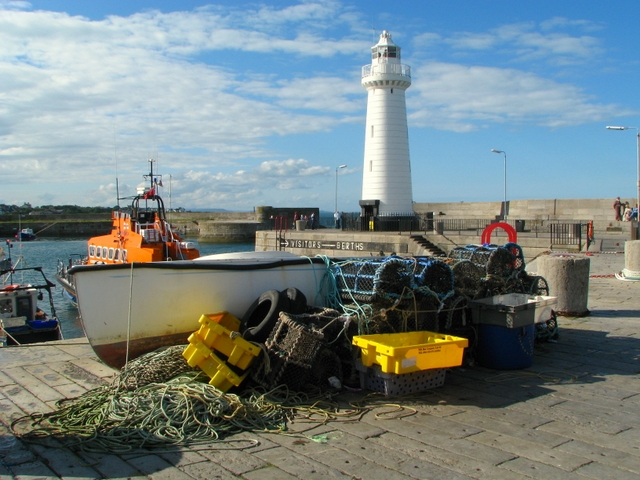
Donaghadee is a harbour town with a long history and seafaring tradition.  The Normans left their mark in the form of a motte which is a main feature of the townscape, now topped by a 19th century building formerly used to store explosives.  In 1662 a sea crossing from Donaghadee to Portpatrick in Scotland was established, a distance of just 22 miles, making it the shortest distance between Ireland and Scotland.  The town’s port was the most important in Northern Ireland before being overtaken by Belfast. The harbour, which was started in at least the 17th century, was enhanced by the addition of a lighthouse.  Construction of the lighthouse with its limestone tower was started in 1836 and it was the first lighthouse in Ireland to be lit by electricity.  Though the sea crossing is no longer used, the town is a popular destination for visitors who want to enjoy the leisure facilities such as angling or walking along the shore enjoying the views across to Scotland.  Donaghadee boasts a pub, Grace Neill’s, which is reputedly the oldest in Ireland.    

In January 1953 the brave lifeboat men of Donaghadee were called out to the aid of a ferry called MV Princess Victoria which had left Stranraer, emerging from the relative safety of Loch Ryan to find itself confronted with severe gales.  This awful weather was part of the same disastrous weather system which was responsible for the flooding and loss of life in other parts of the UK, notably the east coast.  Initially the captain was going to return the vessel to Stranraer, but after being hit by a large wave he changed his mind and headed for Northern Ireland.  The subsequent nightmare journey culminated in the Princess Victoria going under just five miles from the County Down coast.  The crew of the Sir Samuel Kelly from Donaghadee were able to save the lives of 34 of the passengers.  The 135 people who lost their lives included Maynard Sinclair, the deputy prime minister of Northern Ireland.


File:Boat and tackle, Donaghadee - geograph.org.uk - 935175.jpg
Boat and tackle, Donaghadee - geograph.org.uk - 935175. Photo by Ross, via Wikimedia Commons.

Thursday, 1 June 2017

ST JOHN'S POINT AND KILLOUGH


The lighthouse at St John’s Point is striped like many lighthouses, but is distinctive in that the stripes are black and yellow in the manner of a bumble bee.  It is the tallest onshore lighthouse on the Irish coast, having been extended to a height of 40m in the 1880s, and it was automated in 1981.  In 2015 the locals in the area were up in arms about a proposal to replace the six-ton antique lamp with a cheaper LED version.  The headland was immortalised in song by Van Morrison when, in his song Coney Island, he talked of  “stopping off  at St John’s Point”.  Its other claim to fame is that the ill-fated Titanic did her sea trials in the waters off here.

The village of Killough, formerly named St Ann’s Port, lies on the west shore of an almost-enclosed bay.  The present-day name comes from the Irish Cill Locha, meaning “church of the loch”, the church in question being long since gone.  The harbour was built in the 18th century and became an important departure point for the export of locally grown cereals.  However, by the 19th century the port was going into a decline due to the collapse of grain prices.  Around the same time the village became popular as a seaside destination, not least for its attractive tree-lined main street lined with low-rise cottages and pubs.  Killough and Coney Island, facing the village across the bay, had their moment of Hollywood fame in 2012 when they featured in the short film The Shore, directed by local lad Terry George, which won the Academy Award for Best Live Action Short Film.


File:St Johns (19), October 2009.JPG
St John's (19), October 2009. Photo by Ardfern, via Wikimedia Commons.
 

Saturday, 17 September 2016

GODREVY POINT AND GWITHIAN


A few years ago, on one of our many trips down to Cornwall to visit the folks back home, my husband and I turned off the A30 and made our way to Gwithian, from where we followed a National Trust sign along a minor road around to a parking area with a wonderful view of Godrevy Lighthouse.  I had only ever seen the lighthouse from a distance before.  It was a lovely sunny day, and with the lighthouse in one direction and endless stretches of surf  looking towards St Ives in the other, I was captivated by the view.  Godrevy Point is an excellent spot for looking out for dolphins and porpoises, and Mutton Cove is home to a large colony of Grey Seals.  The lighthouse was started in 1858 and lies on a small island just off Godrevy Point.  The main purpose of the lighthouse is to warn seafarers off a reef called the Stones reef, a long-standing hazard to shipping.

Gwithian beach is backed by sand dunes and is set among the Gwithian Towans Local Nature Reserve, also designated a Site of Special Scientific Interest for its diverse flora and fauna, including skylarks and butterflies, guillemots, razorbills and cormorants, while Common Seals can be seen near the beach.  The word ‘Towan’ comes from the Cornish ‘tewyn’, meaning sandhill or dune.  The surfers who flock here are catered for by a couple of laid-back cafes, one of which occupies a former 19th century coastguard lookout.  There are also rock pools and caves for the kids to explore.  

Map of the area


Godrevy Lighthouse, by Barbara Ashley


Saturday, 12 March 2016

HARTLAND POINT AND HARTLAND QUAY


In ancient times Hartland Point’s wild majesty came to the attention of no less than Ptolemy of Ancient Greece, who christened it “The Promontory of Hercules”.  The headland, which marks the point where the western end of the Bristol Channel meets the Atlantic Ocean, is reached by a narrow road leading to a car park above Barley Bay, or alternatively there is a 6-mile stretch of the coastal path from Clovelly.  Standing on a small ‘table’ of land at the base of the cliffs is the whitewash lighthouse with a  helipad, built in 1874 by Sir James Douglass.  Remedial work had to be done in order to mitigate against the erosion of the rock under the lighthouse by the sea.  There have been numerous shipwrecks off the Point over the years, including one dating from 1983 called the MS Johanna, carrying wheat from the Netherlands.  The rusted remains of the hull can still be seen lying forlornly at the base of the cliffs.

Hartland Quay was built under the sponsorship of Sir Walter Raleigh, Sir Francis Drake and Sir John Hawkins during the reign of Elizabeth I.  It was used as a port for shipping produce such as coal until bad storms during the 19th century caused it to start breaking up.  Now Hartland Quay is no more than a place name since nothing remains of the quay itself.  Nearby Hartland Abbey was built on the site of a monastery founded in the 12th century.  The Abbey, which is a private home, is open to visitors in the summer and houses a large collection of Victorian and Edwardian photographs.  There is a woodland walk through the grounds to the coast.

Live streaming webcam view from Hartland Quay Hotel.


File:Hartland Point Lighthouse (6889979228).jpg
Hartland Point Lighthouse (6889979228).  Photo by Becks, via Wikimedia Commons