Labels

Aberdeenshire (21) Angus (4) antiquities (87) Argyll and Bute (35) Arran (7) art (37) birds (231) bridge (9) Caithness (12) Carmarthenshire (5) castle (164) Ceredigion (9) Channel Islands (13) Cheshire West and Cheshire (1) City and County of Swansea (1) City of Bristol (2) City of Edinburgh (4) Conwy (8) Cornwall (74) County Antrim (19) County Down (23) County Durham (3) County Londonderry (4) Cumbria (19) Denbighshire (2) Devon (48) diving (9) Dorset (18) Dumfries and Galloway (22) Dundee City (1) East Lothian (6) East Sussex (16) East Yorkshire (6) English Riviera (3) Essex (17) Fife (19) Flintshire (1) food (12) fossils (14) gardens (28) Ghosts (36) Glamorgan (1) Gower (7) Guernsey (4) Gwent (1) Gwynedd (19) Hampshire (13) Highland (72) Inner Hebrides (42) Inverclyde (5) Islay (8) Isle of Anglesey (14) Isle Of Man (7) Isle Of Wight (10) Isles of Scilly (3) Jersey (7) Kent (22) Lancashire (8) Lewis and Harris (7) lighthouse (62) Lincolnshire (8) Merseyside (8) Mid Glamorgan (1) mining (23) Moray (10) Mull (8) Norfolk (21) North Ayrshire (13) North Yorkshire (12) Northern Ireland (45) Northumberland (17) Orkney (10) Outer Hebrides (14) Pembrokeshire (27) pubs (50) Ross and Cromarty (20) Scotland (299) Scottish Borders (3) Shetland (14) shipwrecks (42) Skye (12) smuggling (48) Somerset (9) South Ayrshire (6) South Glamorgan (5) South Gloucestershire (2) Suffolk (18) surfing (92) Sutherland (16) Tyne and Wear (8) Wales (93) wartime (75) webcams (232) West Dunbartonshire (3) West Glamorgan (9) West Sussex (9)

Tuesday, 7 June 2011

EASTBOURNE

Eastbourne, with its promenade and pier and rows of seafront hotels, has, like Bognor Regis, long suffered a bit of an image problem. The town has rather cruelly been referred to as “God’s waiting room” for the number of elderly visitors frequenting the resort. However recent developments suggest that Eastbourne is reinventing itself and is rapidly turning into a hip venue to rival its near neighbour, Brighton. Recent additions to the town’s attractions include a great new art gallery called the Towner with a cafe on the top floor offering fantastic views.  Add to this a host of new restaurants, several theatres and museums, and a quarter named Little Chelsea stuffed with antiques shops, boutiques and galleries, and one can safely say that while there is still plenty to keep the older generation happy, there is no longer any reason for the young ones to stay away. One of Eastbourne’s big events of the year is the tennis tournament that takes place there each year shortly before Wimbledon. The tournament, which was originally women only, but opened to men in 2009, takes place on grass courts and gives fans a chance to see how their favourite players are doing in the run up to Wimbledon.

Eastbourne was traditionally a favoured retreat for rich widows, and in the mid-1950s there was an investigation into the deaths of 300 of these wealthy widows sparked by an anonymous letter suggesting that the women were the victims of a fraudster. During the investigation, bodies were exhumed and more than 400 wills were examined. The Leader-Post reported that the women may have “fallen under the spell of a man with hypnotic powers”, in fact a hypnotist was questioned during the course of the police investigations. In 1957 the trial took place of an Irish-born GP suspected of persuading wealthy widows to leave him money in their wills, and he was found not guilty, but was eventually convicted for forging of prescriptions, false statements and other misdemeanours. Unbelievably, he was later allowed to resume his work as a general practitioner in Eastbourne. There is a school of thought that the deaths were acts of euthanasia rather than any attempt on the part of the doctor to profit from the wills of the ladies in question. However, others regard him as the forerunner of the latter-day mass murderer Harold Shipman.

For a list of events in Eastbourne, see here.

Live streaming webcam view of the pier.

Map of the area.

File:Eastbourne beach - geograph.org.uk - 1396094.jpg
Eastbourne beach - geograph.org.uk - 1396094. Photo by Raymond Knapman, via Wikimedia Commons

Monday, 6 June 2011

SEVEN SISTERS AND BEACHY HEAD

The stretch of coast just before Eastbourne boasts the neighbouring topographical superstars The Seven Sisters and Beachy Head. The Seven Sisters are essentially a series of seven ‘humps’ on the clifftop, with its striking white chalk face topped with rolling green downland. They came about as a result of the erosion of dry valleys within the downs. There is a country park here taking in the cliffs, river valleys and chalk grassland stretching over 280 hectares.

Beachy Head is one of the most famous headlands on Britain’s south coast, with the highest chalk sea cliff in the country, rising to a height of 162m. This is a place tinged with sadness, being a popular place for suicides and attempted suicides, reckoned to number on average 20 per year. Add to that the loss of life from maritime accidents just offshore, and one shudders to think of the number of lives lost at the hands of Beachy Head. A collision in 1889 between the British vessel Largo Bay and a steamer called the Glencoe resulted in 54 dead, more than half of them Chinese. In 1912 the P & O liner Oceana collided with the German barque Pisagua resulting in 9 lost lives. These are just two examples. Add to this the wartime toll, including the torpedoing of the steamer Haipolian in 1915, and it is hard to conjure up positive feelings about this headland. However, as long as you are not harbouring self-annihilating thoughts, a walk up to Beachy Head can be one of the most exhilarating experiences to be had on the British coast.

Map of the area.

File:Beachy Head (2205).jpg
Beachy Head (2204). Photo by Nilfanion, via Wikimedia Commons

SEAFORD

Seaford has a long history stretching back to at least Roman times. The remains of Roman villas have been found in the locality, a reminder that there was once a Roman station here, and that there was a large Roman camp on the hill above the town. Moving forward to Saxon times, King Alfred The Great had a palace at nearby West Dean, and it is thought he used the area as a base for his fleet in his quest to mount a defence against the Vikings. Seaford subsequently became an important trading port, for exporting wool and importing wine. However, the combined evils of the Hundred Years War and the Black Death led to a serious decline. Nowadays, Seaford is a quiet coastal town whose attractions include the view eastwards towards the Seven Sisters. One of the best places for viewing them is Cuckmere Haven at the mouth of the Cuckmere Valley, an area of downland within the Seven Sisters Country Park which is looked after by the National Trust and visited by a wide variety of birds and over-wintering wildfowl. There is also an array of marine life to be found in the rock pools of Cuckmere Haven.

Map of the area.

File:Seaford beach, East Sussex (2003).jpg
Seaford beach, East Sussex (2003). Photo by Peter Jordan, via Wikimedia Commons


Saturday, 4 June 2011

PEACEHAVEN AND NEWHAVEN

It is one of life’s ironies that the serene-sounding name of Peacehaven came about as a result of a wartime campaign. The settlement, begun in 1914 by Charles Neville, was originally named New Anzac-On-Sea following a competition in the Daily Express to come up with a name. However, the Gallipoli campaign got underway soon after, and this traumatic event forced a rethink, leading to the renaming of the town as Peacehaven. A glance at the map of the town calls to mind a typical American urban space, being laid out in a grid pattern. Some of the original dwellings were decidedly makeshift, making use of railway carriages and army huts. In the early 1920s there was a attempt to inject some glamour into the town with the building of the Peacehaven Hotel, an ornate affair with an opening party whose guests included minor royalty. Sadly, this has since been demolished.

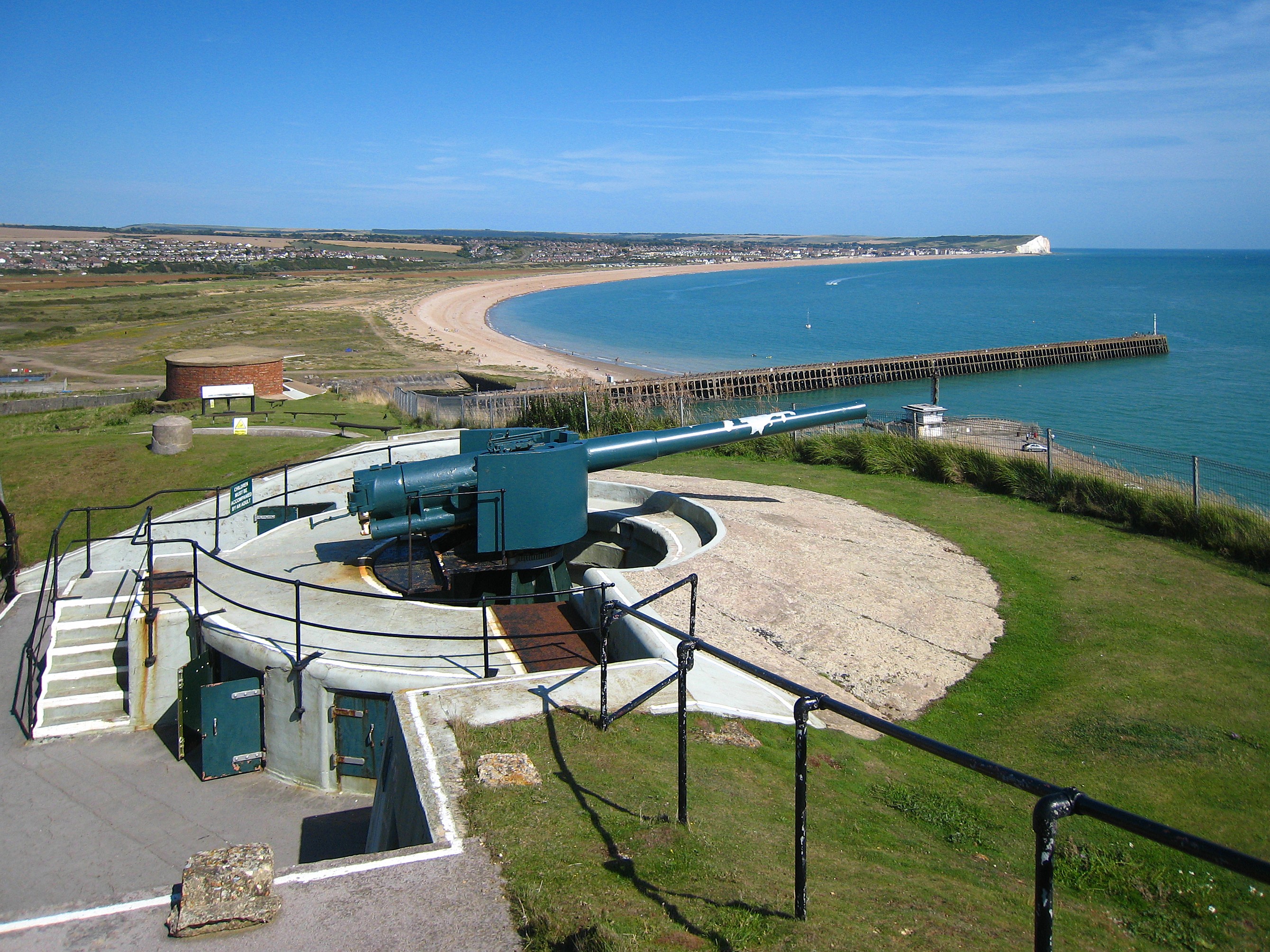
Just to the east of Peacehaven, and at the mouth of the River Ouse, the port of Newhaven boasts ferry connections to Le Havre and Dieppe in France. A more belligerent crossing to Dieppe took place in 1942 involving a number of ports including Newhaven when a largely Canadian force mounted a raid on Dieppe. The raid exacted a heavy toll on the Canadian contingent, leaving 907 dead. The port at Newhaven also played a vital role in the transport of men and supplies during the First World War. Further back in time, in 1848 Newhaven was the landing-place of Louis Philippe, the exiled French king, who crossed the channel in a fishing boat with his queen, travelling under the pseudonym Mr and Mrs Smith. Newhaven Fort, one of a series of forts known as the Palmerston Forts, is open to visitors as a museum.

For a list of events in the area, see here.

Live webcam view.

Map of the area.


File:Newhaven Fort.jpg
Newhaven Fort. Photo by Michael Coppins, via Wikimedia Commons


Friday, 3 June 2011

SALTDEAN

It was in the 1930s, when shorter working hours and paid holidays brought an increase in leisure time, that swimming and sunbathing became popular summertime activities, so it is no coincidence that many of the country’s outdoor swimming pools, or lidos, date from that period, characterised by the simple, linear symmetry of the Art Deco style. The lido at Saltdean is a classic example of the genre, developed in the 1930s, and promoted as “The Coming Resort”. Many of the country’s lidos sadly closed down as tastes changed and attendance fell, but the lido at Saltdean is still up and running. Last year, however, the Lido’s future was threatened by a plan to fill it in and build 102 flats over it. This plan was fought by the Save Saltdean Lido Campaign being run by the Friends of Saltdean Lido. Lets hope they succeed in their quest to preserve this Art Deco gem. For those preferring to swim in the sea, the beach at Saltdean is shingle backed by chalk cliffs, and there are rock pools at low tide.  (Postscript: I am happy to report that in 2018 the lido is still going.  Well done to the campaign.)

Another Art Deco masterpiece which has been turned into flats is the former Grand Ocean Hotel, whose guests in its heyday included Bette Davis. The hotel was designed by Richard Jones, who also designed the Lido, and opened in 1938. The holiday camp entrepreneur Billy Butlin bought the site in 1953 for £250,000, and one of the redcoats working there was Jimmy Tarbuck, who was later destined to carve out a career as a well-known comedian. However, the advent of holidays to sun-soaked continental destinations brought about a decline to such places and the Grand finally closed in 2005.

Map of the area.

File:Saltdean Lido - geograph.org.uk - 634728.jpg
Saltdean Lido - geograph.org.uk - 634728. Photo by Simon Carey, via Wikimedia Commons


ROTTINGDEAN

Rottingdean is a village just to the east of Brighton, but which comes under the Brighton and Hove administrative area. In the 18th and early 19th centuries the village was a hive of smuggling activity, the contraband being stored in a maze of underground cellars below the High Street. Rottingdean’s most prominent landmark is the old windmill located high above the village on Beacon Hill, so named because it was here that a beacon was lit to warn of the approaching Spanish Armada. The mill dates from 1802, and continued to grind corn until 1881. It is now looked after by the local Preservation Society.

Probably the most famous resident of Rottingdean was the writer Rudyard Kipling, who moved there with his uncle the painter Sir Edward Burne-Jones in 1897. It was there that he wrote one of his most famous works, the Just So Stories. He also wrote “A Smuggler’s Song” after moving away from the village, which was probably inspired by the aforementioned smuggling trade. His old house is adjacent to the gardens named after him, Kipling Gardens. It appears he had a rocky relationship with his neighbours. In 1902 the Sunday Vindicator reported that Rottingdean residents were outraged when Kipling’s aunt displayed a pro-Boer banner, which “provoked a tumultuous assemblage of the villagers”, who were met by Kipling with “the use of sundry forceful expletives”. This incident made him so unpopular with the locals that he moved to a new home near Tunbridge Wells, making the excuse that he was fed up with the large numbers of his fans descending on him in Rottingdean.

Map of the area.

File:Beach Huts, Rottingdean - geograph.org.uk - 227900.jpg
Beach Huts, Rottingdean - geograph.org,uk - 227900. Photo by David Eldridge, via Wikimedia Commons


Wednesday, 1 June 2011

BRIGHTON AND HOVE

Brighton, which played a starring role in the 1938 novel Brighton Rock by Graham Greene, is undoubtedly the main rival to Bournemouth for the title of premier south coast resort. It has been described as London-on-sea, due to its relative proximity to the capital. Brighton and the adjoining resort of Hove are essentially one big community, named Brighton and Hove for administrative purposes. The resort used to have two piers, but one of them, the West Pier, burned down in 2003. It subsequently remained in situ, looking rather sad, but there are now plans to install a glamorous new attraction at the site, namely the i360, described as “a slender, elegant observation tower” capable of elevating its passengers to a height of 150 meters above sea level, giving panoramic views of the seafront. The other pier, the Palace Pier, remains in place in spite of having endured a number of mishaps over the years, including an attempted IRA bomb attack in 1994. Viewed from the Palace Pier, Brighton has a slightly depressing high-rise appearance, but behind this modern facade there is a charming labyrinth of streets dating from an earlier age called The Lanes, offering an array of smart little shops, restaurants and pubs. Brighton has a thriving gay community, and each summer there is a massive Gay Pride parade.

Just to the east of the Lanes is Brighton’s most famous land was built to look like an Indian palace, and looks comically incongruous with itsmark, which looks as though it belongs not only to a different age, but to a far-flung country. The Brighton Royal Pavilion was built to look like an Indian palace, and looks comically incongruous with its riot of domes and other exotic Indian features. It houses one of the finest collections of chinoiserie in Britain. It was built by John Nash as a seaside home for the Prince Regent, George, Prince of Wales, later King George IV, and construction commenced in 1787.

In the late 1800s, Magnus Volk, son of a German clockmaker, who was born in Brighton, built a tourist attraction which was a rival in eccentricity even for the Pavilion. Nicknamed the “Daddy Longlegs”, it was a “Seashore Electric Tramroad” consisting of a vehicle with 24-foot long legs, each with four wheels on the end, with two open decks, which could carry up to 150 passengers for 3 miles along the seafront to neighbouring Rottingdean. It was powered by electric cables which ran along a row of wooden poles. Sadly, this bizarre example of 19th century inventiveness was destroyed by a severe storm one week after opening, although it was rebuilt, only to close again in 1910. One of Volk’s earlier projects, however, was much more long-lived, in fact it still runs today. August 1883 saw the opening of Volk’s Electric Railway, the world’s first public electric railway. During the summer months it is possible to travel on this eminent piece of engineering from the Aquarium to Black Rock.  Just beyond the latter is the Marina with an array of shops and restaurants.

Brighton Festival, one of the country’s biggest and most well-established arts festivals, takes place in early summer each year. For other events, see here.

Live streaming webcam view of the pier.

Map of the area.

File:Brighton, The Palace Pier - geograph.org.uk - 869745.jpg
Brighton, The Palace Pier - geograph.org.uk - 869745. Photo by Martyn Gorman, via Wikimedia Commons