Labels

Aberdeenshire (21) Angus (4) antiquities (87) Argyll and Bute (35) Arran (7) art (37) birds (231) bridge (9) Caithness (12) Carmarthenshire (5) castle (164) Ceredigion (9) Channel Islands (13) Cheshire West and Cheshire (1) City and County of Swansea (1) City of Bristol (2) City of Edinburgh (4) Conwy (8) Cornwall (74) County Antrim (19) County Down (23) County Durham (3) County Londonderry (4) Cumbria (19) Denbighshire (2) Devon (48) diving (9) Dorset (18) Dumfries and Galloway (22) Dundee City (1) East Lothian (6) East Sussex (16) East Yorkshire (6) English Riviera (3) Essex (17) Fife (19) Flintshire (1) food (12) fossils (14) gardens (28) Ghosts (36) Glamorgan (1) Gower (7) Guernsey (4) Gwent (1) Gwynedd (19) Hampshire (13) Highland (72) Inner Hebrides (42) Inverclyde (5) Islay (8) Isle of Anglesey (14) Isle Of Man (7) Isle Of Wight (10) Isles of Scilly (3) Jersey (7) Kent (22) Lancashire (8) Lewis and Harris (7) lighthouse (62) Lincolnshire (8) Merseyside (8) Mid Glamorgan (1) mining (23) Moray (10) Mull (8) Norfolk (21) North Ayrshire (13) North Yorkshire (12) Northern Ireland (45) Northumberland (17) Orkney (10) Outer Hebrides (14) Pembrokeshire (27) pubs (50) Ross and Cromarty (20) Scotland (299) Scottish Borders (3) Shetland (14) shipwrecks (42) Skye (12) smuggling (48) Somerset (9) South Ayrshire (6) South Glamorgan (5) South Gloucestershire (2) Suffolk (18) surfing (92) Sutherland (16) Tyne and Wear (8) Wales (93) wartime (75) webcams (232) West Dunbartonshire (3) West Glamorgan (9) West Sussex (9)

Monday, 23 January 2012

FINDOCHTY

The houses that cluster around the harbour of this Moray fishing village are brightly painted, making it one of the most attractive villages along this stretch of coast. The earliest recorded instance of the name was in 1440, while the following century the land around the port was acquired by the Ord family, who built a castle there, now a ruin. It was also the Ords who established the fishing activity in the port. Like so many of the smaller fishing villages, this facet of the economy has now largely been given over to leisure pursuits, but a reminder of the village's past as a fishing port remains in the form of a statue of a fisherman watching over the harbour, created by a local artist. There are many caves in the coast around here, and in 1899 prehistoric bones were discovered in one of them, identified as having been fashioned into implements. Walkers can strike out along the cliff top paths towards Portknockie to the east or Buckie to the west. Caravanners who are dolphin enthusiasts are in for a treat here in Findochty, because the caravan park looks out onto a bay where the famous Moray Firth dolphins can sometimes be seen.

Map of the area.

Findochty Harbour - geograph.org.uk - 688561. Photo by Ann Harrison, via Wikimedia Commons.


Sunday, 22 January 2012

PORTKNOCKIE

Examples of artistic inspiration can be found all over the British coast, whether in the form of an artist's depiction of the scenery and local life of the area displayed in a gallery, or an unusual artistic community project. An example of the latter was unveiled in 2009 in the Moray village of Portknockie. A local artist collected handprints from residents of the village and combined them in a mosaic which was used as a piece of outdoor artwork. The mosaic depicted images representative of the village, including two fish 16 feet long, as depicted in the village's coat of arms.

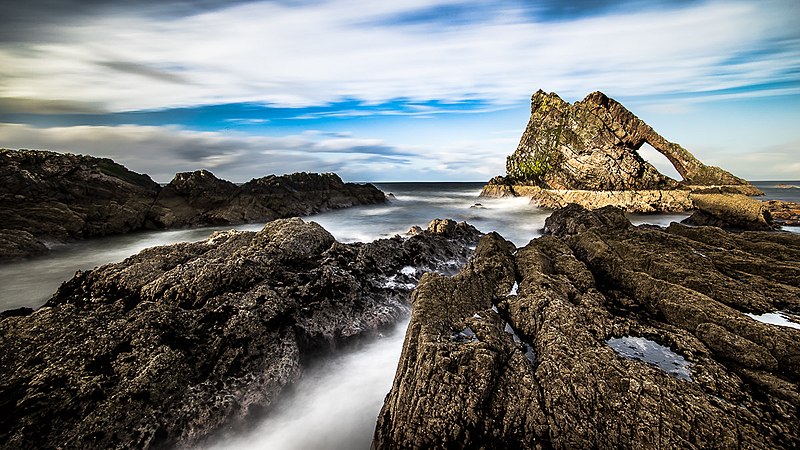
Portknockie, a fishing village in Moray just inside the border with Aberdeenshire, was founded in 1677 and during the 19th century became important for herring fishing. The harbour is overlooked by Green Castle, which was once a Pictish stronghold. The stretch of coast around Portknockie is known for its striking coastal scenery, which includes wierd and wonderful shapes and arches, the best known of which is the Bow and Fiddle which emerges from the sea just offshore. There are also a number of caves, one of which, the Preacher's Cave, was used as a church in the early 19th century. A walk along the cliff top towards Findochty provides wonderful views across the Moray Firth to the Black Isle.

Map of the area.

Bow Fiddle, Portknockie Scotland United Kingdom (103630775). Photo by Giuseppe Milo, via Wikimedia Commons.


Friday, 20 January 2012

CULLEN

There are many delights for food lovers in Scotland, but one of the most enjoyable to my mind are the lovely, warming soups which are especially welcome in the chilly climate of this northern corner of the British Isles. One of the best known Scottish soups is Cullen Skink, which tastes much better than its rather uninviting name suggests; its main ingredients are smoked haddock, potatoes and onion, smoked haddock being a regular feature in the diet on this stretch of coast. On his visit to the town, Samuel Johnson, in his usual forthright manner, declared himself to be disgusted by the sight of "dried haddock broiled", so much so that he refused to eat it for breakfast. But don't let him put you off trying this local delicacy.

Cullen is a resort built on two levels, set on the beautiful Cullen Bay. The lower part is the fishing village of Seatown, built in the typical style of a traditional Aberdeenshire fishing village, while the upper village, a former royal burgh, has a square boasting an ornate market cross dating from 1696. The two parts are separated by a disused railway, whose viaducts are used by walkers and cyclists and offer wonderful views, matched only by the views from the local Golf Club. The wife of Robert The Bruce died in the area, and her organs are thought to be buried in Cullen's Auld Kirk, which dates from at least the 14th century. Cullen Burn is believed to equate to the River Celnius, which was mentioned by Ptolemy in "Geography", written around 139-161.

Map of the area.

Seatown and Cullen Bay - geograph.org.uk - 688640. Photo by Ann Harrison, via Wikimedia Commons.


Tuesday, 17 January 2012

SANDEND AND FINDLATER CASTLE

The traditional fishing village of Sandend was established before the early 1600s, meaning it predates many of the other fishing communities around this area. It has one of Scotland's smallest harbours, backed by short streets consisting of tightly knit houses running at right-angles to the sea. Sandend Bay has a fine sandy beach perfect for walking the dog. Overlooking the bay to the east of the village is the Glenglassaugh Distillery, founded in 1875. The distillery was revived in 2008 after being mothballed in 1986, and is known for its single malt whisky. Visitors are welcome, although there is no visitor centre as yet, and they can purchase award-winning aged whiskies as well as younger drinks.

West of Sandend is the ruined Findlater Castle, which clings precariously to an outcrop of rock, so weathered that it almost looks like a natural extension of the cliff top. There have been fortifications here since at least the 13th century, although the original structure was lost during an attack by the Danes, and what you see now probably dates from the 14th century, when it was owned by the Sinclairs. The castle was passed to the Ogilvies in the 15th century, one of whose offspring, James Ogilvie, a Steward to Mary Queen of Scots, was disinherited and the castle passed to Sir John Gordon. However, James was having none of this and set out to regain the land from the new incumbent. Mary Queen of Scots sent troops to seize the castle, and to cut a long story short, a series of battles ensued culminating in Gordon's beheading, upon which the castle was returned to the Ogilvies, but not for long because they moved to Cullen around 1600.

Map of the area.

Findlater Castle Scotland. Photo by Ingo Wölbern, via Wikimedia Commons.


Sunday, 15 January 2012

PORTSOY

Anyone who loves traditional boats should head to Portsoy for the Scottish Traditional Boat Festival which takes place in late June. Traditional boats from far and wide congregate on the harbour here, while the festival itself showcases traditional crafts such as boat building, knitting, music and art. Hungry visitors also have a food fayre to whet their appetites.

Portsoy, established as a Burgh by Mary Queen of Scots, was one of the earliest ports to be established along the Moray and Aberdeenshire coasts. Portsoy has the oldest harbour on the Moray Firth, and its 17th century warehouses remain as a reminder of past glory. One of the warehouses acts as a workshop for a decorative stone known as Portsoy Marble, a variety of serpentine whose uses included parts of the Palace of Versailles. The Salmon Bothy is a former Salmon House which has been converted into a museum. The coastal path heading out of Portsoy offers views of fascinating rock formations as well as the chance to see the dolphins for which the Moray Firth is so well known.

Map of the area.

PORTSOY HARBOUR. Photo by Michael Garlick, via Wikimedia Commons.


Saturday, 14 January 2012

BANFF

If you google Banff and find yourself confronted with majestic snow-covered mountains, ski runs and line-dancing saloons, you've got the wrong Banff: this is the Banff in the Canadian Rockies. The Scottish town from whence the New World version got its name is a very different proposition: once one of the most important ports in medieval Scotland, now a gracious seaside town with a mix of architectural styles separated from its neighbour Macduff by a seven arched bridge built by John Smeaton, a name we last encountered in Plymouth with Smeaton's Tower. In 1700 a kind of Scottish version of Robin Hood called James MacPherson was hanged in Banff following a robbery rampage during which he targetted only the rich.

On the outskirts of town, in the Deveron Valley, is the 18th century Duff House, a stately Georgian pile designed by William Adam and nowadays functioning as an art gallery, with paintings and furniture on loan from the National Galleries of Scotland. Banff Museum is one of the oldest museums in Scotland and, among other treasures, displays a collection of Banff silver. The ruined parish kirk of St Mary's was rebuilt in 1471 but demolished in 1797. The aisle was spared, though, and was restored in 2001 courtesy of the Heritage Lottery Fund, since it was the burial place of the Ogilvies, one of the most important families in Banffshire. The churchyard has further tombs belonging to past townsfolk from all walks of life.

For events in Banff and the surrounding area, follow this link.

Map of the area.

Banff Harbour - geograph.org.uk - 404671. Photo by Dominic Moore, via Wikimedia Commons.


Wednesday, 11 January 2012

MACDUFF

The River Deveron spews into the Moray Firth at Banff Bay, where Macduff on the east side of the bay and Banff on the west side stare across at each other. The little fishing town of Macduff started off as the hamlet of Doune, although there are signs of an earlier Neolithic Celtic settlement in the area. It was James Duff, son of William, who had bought the land in 1733, who came up with the name Macduff. The hamlet grew into a town with a fishing fleet largely going after herring, although the decline of the herring stocks required a diversification into other species. Another mainstay of the economy was shipbuilding.

Marine life in modern-day Macduff is a tourist attraction as well as a source of food. The town's aquarium is a showcase for the rich and varied wildlife of the Moray Firth, while the Guide Charters boat trips offer tourists a chance to see Moray creatures such as gannets, whales and dolphins, running 3-hour trips to the RSPB site at Troup Head, which houses the only gannet colony in mainland Scotland. Meanwhile, for walkers, the Speyside Way long distance trail passes through Macduff.  The town's golf club, the Royal Tarlair, lies in an attractive coastal location.

Map of the area.

Macduff Harbour - geograph.org.uk - 861356. Photo by Anne Burgess, via Wikimedia Commons.