Labels

Aberdeenshire (21) Angus (4) antiquities (87) Argyll and Bute (35) Arran (7) art (37) birds (231) bridge (9) Caithness (12) Carmarthenshire (5) castle (164) Ceredigion (9) Channel Islands (13) Cheshire West and Cheshire (1) City and County of Swansea (1) City of Bristol (2) City of Edinburgh (4) Conwy (8) Cornwall (74) County Antrim (19) County Down (23) County Durham (3) County Londonderry (4) Cumbria (19) Denbighshire (2) Devon (48) diving (9) Dorset (18) Dumfries and Galloway (22) Dundee City (1) East Lothian (6) East Sussex (16) East Yorkshire (6) English Riviera (3) Essex (17) Fife (19) Flintshire (1) food (12) fossils (14) gardens (28) Ghosts (36) Glamorgan (1) Gower (7) Guernsey (4) Gwent (1) Gwynedd (19) Hampshire (13) Highland (72) Inner Hebrides (42) Inverclyde (5) Islay (8) Isle of Anglesey (14) Isle Of Man (7) Isle Of Wight (10) Isles of Scilly (3) Jersey (7) Kent (22) Lancashire (8) Lewis and Harris (7) lighthouse (62) Lincolnshire (8) Merseyside (8) Mid Glamorgan (1) mining (23) Moray (10) Mull (8) Norfolk (21) North Ayrshire (13) North Yorkshire (12) Northern Ireland (45) Northumberland (17) Orkney (10) Outer Hebrides (14) Pembrokeshire (27) pubs (50) Ross and Cromarty (20) Scotland (299) Scottish Borders (3) Shetland (14) shipwrecks (42) Skye (12) smuggling (48) Somerset (9) South Ayrshire (6) South Glamorgan (5) South Gloucestershire (2) Suffolk (18) surfing (92) Sutherland (16) Tyne and Wear (8) Wales (93) wartime (75) webcams (232) West Dunbartonshire (3) West Glamorgan (9) West Sussex (9)

Monday, 31 October 2011

ABERLADY

Moving along the south shore of the Firth of Forth from North Berwick, we pass the village of Dirleton; nearby is the Yellowcraig nature trail which offers views across to Fidra, an island with a puffin colony. A few miles further on, the village of Gullane has no less than five golf courses, one of which, Muirfield, has hosted several Open championships.

Aberlady once served as the seaport for the nearby inland town of Haddington. One reminder of this time is the 17th-century custom house. The parish church has a stone outside known as a “loupin’-on” stone”, which allowed riders to mount their horses more easily. Aberlady Bay is a nature reserve visited by opsreys and Montagu’s harriers among other birds. Between Aberlady and Longniddry is the impressive 19th century Gosford House, completed in 1891, which is used for events and has its own golf course.

Map of the area.

Aberlady Beach 2019 02 (48379348471). Photo by Ian Robertson, via Wikimedia Commons.


Sunday, 30 October 2011

GHOSTS OF THE COAST

The British coast has been the scene of so many dramatic events over the centuries, many involving murder and mayhem, that it is not surprising that there are many ghost stories associated with our coast. On the occasion of Halloween, here is a selection of the best coastal ghost stories.

Old inns on the coast are a particularly rich source of ghost sightings. The Dolphin Inn in Penzance is frequented by an old salty seadog called George. George has been heard tramping around the inn, his heavy footsteps quite out of keeping with the present-day carpeted surfaces. Another story describes a fair-haired figure appearing at the foot of a bed in the inn.

The smuggling activities which took place around the British coast in the past are another source of hauntings. In Weybourne, Norfolk, there is a mysterious whistling sound which can be heard at dusk on nights when the full moon is due. One person who witnessed this phenomenon thought they could make out the outline of a man standing on the shore. Legend has it that this was the ghost of John Smythe, a smuggler who operated many years earlier.

The erosion which is a feature of huge swathes of our coast has led to whole communities being swallowed up by the sea. One of the most famous of these is Dunwich, a former major seaport which was washed away by the sea in the 14th century. Submerged church bells are still heard to this day, warning of coming storms, while shadowy figures, thought to be the ghosts of former inhabitants, are sometimes seen on the clilff tops.

Many apparitions stem from people who have been put to death for a misdemeanour. For example, on stormy winter nights in Gosport, clanking sounds can be made out on Blockhouse Point. These are thought to come from the chains of Jack the Painter who was hanged for starting a fire in the harbour ropehouse in 1776. In Meeting House Lane in Brighton, the ghost of a monk who was walled up alive for running away with a local girl is often seen disappearing through a bricked-up doorway next to the Friends’ Meeting House.

Other supernatural phenomena have come about as a result of the dark arts which were practised in the past. In Reculver on stormy nights babies’ cries can be heard. In the 1960s a number of babies’ skeletons were unearthed by archaeologists, the theory being that they were buried alive during sacrifices.

Castles are always a reliable source of ghostly activity given the often violent history associated with them. At Skipness Castle at the mouth of Loch Fyne the ghost of a “gruach” – a small long-haired spirit – also known as the Green Lady – is said to have defended inhabitants of the castle when danger loomed. At Flamborough, the ghost of a headless woman known as the “White Lady” haunts Danes’ Dyke earthwork west of the village. At Margam Castle, near Port Talbot, the very angry ghost of a gamekeeper called Robert Scott is seen climbing the steps of the house, or on the Gothic staircase inside. Doors are slammed and objects are thrown. Scott is said to have died at the hands of a poacher. There have also been reports of laughing children and the sound of footsteps in the building.

These are just some of the many ghost stories associated with the British coast and its fascinating past. So on this Halloween, mind your backs, but don’t shy away from discovering our incredible coastline!

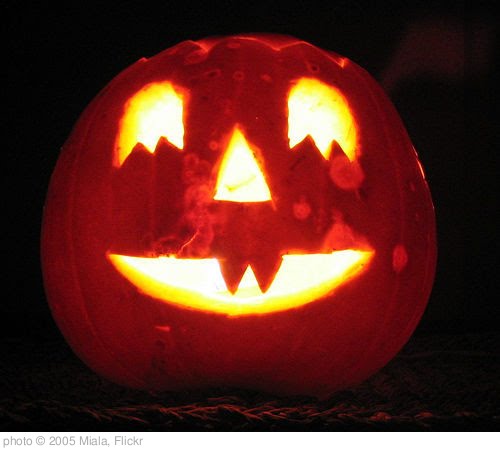
'Halloween' photo (c) 2005, Miala - license: http://creativecommons.org/licenses/by-sa/2.0/

Saturday, 29 October 2011

NORTH BERWICK

On the shore opposite Bass Rock lie the clifftop ruins of the 14th century Tantallon Castle, once the seat of the Douglas Earls of Angus, which offers views down to the sea below which would cause those with a fear of heights to run screaming, as well as a magnificent view of Bass Rock. Anyone planning to visit on Halloween should beware: a couple of years ago it was reported that a photograph was taken at the castle which was deemed to be the world’s most convincing ghost snap. The photograph of a group of family members revealed another figure in the background dressed in Tudor garb.

Further round the coast, at the entrance to the Firth of Forth, is the town of North Berwick. The tiny harbour here is reached through narrow streets and adjacent to the harbour wall is the 12-century Auld Kirk. The Auld Kirk is believed to have had a Christian settlement in the 7th century, and in 1999 archaeological investigations revealed a burnt circle and Roman coins. In 1590 the Auld Kirk was the scene of the North Berwick Witch Trials in which a number of people from East Lothian were accused of witchcraft, including Francis Stewart, 5th Earl of Bothwell. The confessions of the accused were extracted by torture. Auld Kirk Green was the scene of covens held by the “witches”. Nowadays, North Berwick is the Headquarters of the Scottish Seabird Centre, which offers a range of activities, including boat trips out to Bass Rock (see previous post). The Center was the recipient of the Queen’s Award for Enterprise in 2009. The John Muir Way (see Dunbar post) passes through the town.  In an area known as Lodge Grounds is a Holy Well known as St Andrew's Well.

Map of the area.

North Berwick Bay - Looking east towards the harbour - geograph.org.uk - 1897917. Photo by Richard West, via Wikimedia Commons.


BASS ROCK

When I started this blog I made a conscious decision not to include any uninhabited islands - I had enough to be going on with with the inhabited ones! However, I have decided to make an exception in the case of Bass Rock, because it is of such significance for its amazing bird population that it would be a crime to leave it out. In actual fact, Bass Rock has not always been uninhabited. A Lindisfarne monk called Baldred who was sent to convert the heathen Lothians to Christianity in the 8th century used the island as a retreat for prayer and meditation. There is a chapel on the Rock dedicated to him. Later, in the 15th century, a castle was built which was where James, later to become James I, was sent to wait for a vessel to transport him to France. James later used the rock as a place of incarceration for his political enemies. Later still, Mary Queen of Scots had a garrison of 100 men stationed on the rock.

The people who occupied this rock at various times in history would have needed earplugs during the nesting season. There are 80,000 occupied nest sites on the island. The island is best known for its gannet population, in fact the ornithologists who came to study the birds in the 19th century bestowed the gannets with the scientific name Sula Bassana, the Latin version of the rock’s name. Another statistic to conjure with: Bass Rock holds 10% of the population of North Atlantic Gannets. Such is the significance of the Rock that David Attenborough, no less, described it as “one of the wildlife wonders of the world”. You would think that with all these gannets there would be no room for any other birds on this little island, but the gannets share their space with a number of other species, including puffins, guillemots and eider ducks. The Scottish Sea Bird Centre in North Berwick offers boat trips out to the Rock, including some with the possiblity of landing there. 

BassRockNB. Photo by Honge, via Wikimedia Commons.


Thursday, 27 October 2011

DUNBAR

Heading north from St Abbs, a group of skeletal remains on a mound of rock are all that remain of Fast Castle, which dates back at least to the 14th century. The castle is believed to have been the inspiration for Sir Walter Scott’s “Wolf’s Crag”, from his novel “The Bride of Lammermoor”. A bit further along the coast are the red cliffs of Pease Bay and the neighbouring fishing village of Cove, where a tunnel was cut through the cliffs to give local fishermen access to a now-disused curing house.

One would like to think that it was a childhood spent surrounded by the natural splendour of Scotland which led to John Muir becoming a champion of wilderness preservation in America. Muir was born in Dunbar but his family emigrated to the United States in 1849. Muir became a nature writer and activist, playing a big part in efforts to save such iconic American wilderness areas as Yosemite and Sequoia National Parks. Today, his connection to this South-East corner of Scotland lives on in the John Muir Way, a 45-mile path from Musselburgh near Edinburgh to Dunglass. There is also the John Muir Country Park which includes 8 miles of beaches and other varied habitats frequented by a variety of birdlife. Muir’s birthplace in Dunbar is now a museum.

Dunbar is a former Royal Burgh – a Scottish town granted a royal charter. Its relative proximity to Edinburgh makes it a popular dormitory town for people working in the Scottish capital. It was inhabited as far back as the Iron Age, and there are exhibits dating from this time on display in the 17th century Town House. Dunbar’s Victoria Harbour was built in the 1840s, but the castle which forms part of it was built in the 13th century. The castle was once occupied by Mary Queen of Scots, who fled here when heavily pregnant with the future James VI of Scotland following a murder instigated by her husband. The following year, she was brought back here by the Earl of Bothwell when he abducted her on her way back from visiting her son at Stirling.

For a list of events in Dunbar see here.

Live streaming webcam view from Dunbar Golf Club.

Map of the area.

Looking Along The Massive Harbour Wall at Victoria Harbour, Dunbar - geograph.org.uk - 1957431. Photo by Richard West, via Wikimedia Commons.


Wednesday, 26 October 2011

ST ABBS

During our last holiday in Northumberland, on a glorious sunny June day, we nipped over the border to St Abbs, where we parked at the Visitor Centre just outside the village and set off over the clifftops on a short but exhilarating walk to St Abbs Head. The nature reserve here is exceptionally well-endowed with nesting seabirds such as kittiwakes, guillemots and puffins as well as a variety of flora and fauna. The reserve contains a loch called Mire Loch, formed from a geological fault, which is frequented by swans, tufted ducks and grebes. There is a voluntary marine reserve here which runs educational activities and rock-pool rambles. Last month there were reports of a basking shark off St Abbs Head, and another sighting at the entrance to St Abbs harbour.

Back in the village, which is named after a Northumbrian princess called Ebba, a busy fishing port awaits, with the promise of fresh crab rolls. The village is used as a base for divers wanting to explore the voluntary marine reserve, while just around the corner is the sandy beach at Coldingham Bay, which is popular with surfers. There is a surf shop here with a webcam which can be viewed from its website for those wanting to check out the conditions.

Map of the area.

St Abbs Head from St Abbs. Photo by Mick Knapton, via Wikimedia Commons.


Tuesday, 25 October 2011

EYEMOUTH

In my last post about Burnmouth, I described the tragic events of 1881 when large numbers of fishermen were lost to a sudden, furious storm. Eyemouth lost a large proportion of the 189 men and boys who died on that October day, which has come to be known as Black Friday. To this day the fleet refrains from sailing on a Friday as a mark of respect for the victims. The local museum, which tells the port’s history since the 13th century, displays a tapestry commemorating the tragedy. Today, Eyemouth celebrates its still thriving fishing trade every July with the Herring Queen ceremony, in which the newly crowned queen is escorted by the fleet from St Abbs to Eyemouth.

Another ‘industry’ for which Eyemouth was renowned in the past was the smuggling trade. As the closest Scottish port to the continent, Eyemouth was particularly prized by smugglers. There were secret passages and concealed storage areas all over town, but the Headquarters of the illicit activities was the 18th century Gunsgreen House, which still dominates the harbour. Smugglers made use of the roof of the house to hide their ill-gotten gains as well as spaces hidden behind the walls, and even a space behind a fireplace that swung open. Nowadays, the house, which was designed by James, younger brother of the architect Robert Adam, and built by a local merchant and smuggler called John Nisbet, is open to visitors wanting to discover more about the town’s smuggling past. It also has a holiday rental apartment sleeping up to eleven guests. On the other side of Eye Water, from where the town gets its name, is the Eyemouth Golf Club.

Map of the area.

Yachts Eyemouth Harbour. Photo by Peter Nisbet, via Wikimedia Commons.